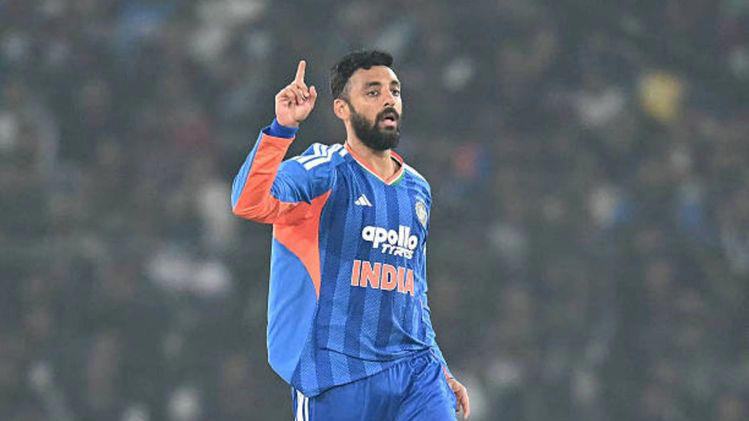
India’s clash with South Africa in the second T20I of the five-match series delivered fireworks, but amid all the noise, one man quietly rewrote the script with the ball—Varun Chakravarthy. On a night when nearly every Indian bowler felt the sting of South Africa’s relentless hitting, Chakravarthy stood tall, held his nerve, and produced a spell that not only kept India afloat but also etched his name deeper into the record books.
His 2/29 in four overs may seem like a modest return at first glance, but within the context of a high-scoring match and a fiery South African batting display, it turned out to be nothing short of heroic. In a game where bowlers were dismantled left and right, Chakravarthy was the only Indian bowler to maintain an economy rate under eight. And he didn’t just contain—he struck at crucial moments. The dismissals of Reeza Hendricks and Aiden Markram were massive breakthroughs, keeping India’s hopes alive.
What makes this performance even more special is the consistency behind it. Chakravarthy didn’t just deliver on the night; he backed up what has now become a habit of troubling South Africa’s batters. With his latest two wickets, Chakravarthy overtook Keshav Maharaj to become the second-highest wicket-taker in T20Is played between India and South Africa. And he has achieved this remarkable feat in just six games—a testament to his sharp variations, unorthodox style, and uncanny ability to get wickets even in batting-dominated conditions.
Arshdeep Singh still tops the elite list with 20 wickets in 12 games, but Chakravarthy has now jumped to second place with 16 wickets, surpassing Maharaj’s 15. What stands out is not just his wicket tally, but the efficiency and impact of his performances. While other bowlers have played significantly more matches to claim their spots, Chakravarthy has stormed onto the list with an influence that is impossible to ignore. Behind him on the list are some of the most dependable names—Bhuvneshwar Kumar with 14, Axar Patel with 13, and South Africa’s Lungi Ngidi with 13.
When the numbers speak so loudly, you know the performances behind them have been consistently special.
But to understand the magnitude of Chakravarthy’s feat, one must look at the match situation. South Africa put up a commanding total—213/4 in their 20 overs. And this was not just any ordinary innings—it was a storm led by Quinton de Kock, who unleashed a jaw-dropping 90 off just 46 balls. De Kock’s innings was the kind that sucks the life out of bowlers: powerful, effortless, and unrelenting. At one point, he looked all set for a century, but even without the milestone, his knock set the tone for South Africa’s dominance.
The Proteas didn’t lose momentum after de Kock’s departure either. A solid finishing partnership between Donovan Ferreira and David Miller—worth 53 runs—propelled South Africa past the 200-run mark with ease. Ferreira’s unbeaten 30 off 15 and Miller’s steady 20* ensured that the pressure piled on India like a mountain.
In a game tilted so heavily in the batters’ favour, Chakravarthy’s spell stood out like a lighthouse in a storm. While others were being hit out of the park, his subtle variations, deceptive pace, and tight lines forced the batters to think twice. He wasn’t just bowling—he was outsmarting, out-planning, and out-classing. And that’s what makes him such a dangerous proposition in T20 cricket.
Every wicket he picked came at a moment when India desperately needed a breakthrough. Hendricks, known for his stability at the top, was removed right when he looked to push the scoring further. Markram’s wicket was even more crucial—South Africa’s captain and one of their most destructive hitters was undone by Chakravarthy’s precision. These were not just wickets; they were momentum shifters.
This match also highlighted how much India relies on Chakravarthy now when it comes to the shortest format. His performances against South Africa have been consistently impressive—two wickets in the first T20I, followed by another two in the second. It’s not often that a bowler troubles the same batting lineup repeatedly, but Chakravarthy has found the formula. The Proteas have world-class players who thrive under pressure, but the mystery spinner has kept them guessing time and again.
Beyond the skill, what stands out about Chakravarthy is his composure. T20Is are unforgiving. One bad over can dismantle a bowler’s confidence. But Chakravarthy bowls like a man who is unshakeable. Whether it’s powerplay overs, middle overs, or late overs, he is calm, focused, and most importantly, effective.
On a night where South Africa’s batting supremacy threatened to overshadow everything else, Chakravarthy ensured India still had a bright spot. His climb up the elite wicket-takers list is not just a statistic—it is a reflection of hard work, evolution, and mastery in a role that often goes unnoticed when batters steal the limelight.
With the series heating up and both teams showing immense firepower, the next few matches could become even more thrilling. India will need their batters to step up massively if they hope to chase down totals like 214. But equally, they will need bowlers like Chakravarthy to continue delivering breakthroughs at crucial stages.
Every great T20 series has a storyline, and in this one, Varun Chakravarthy is undeniably emerging as one of the central characters.
His rise is not just good news for India—it’s a sign that mystery spin still has a place in modern cricket, even in an age dominated by monstrous hitting and fearless strokeplay. And as long as he continues to weave magic with the ball, India will always have a weapon that can turn matches around.
Varun Chakravarthy has overtaken legends, stunned world-class batters, and stood tall in tough moments. And with the series still alive, the best may yet be to come.
And aslo read our old blogs : Fact or fiction? OpenAI researcher breaks silence on Meta’s alleged $100M signing bonus.”