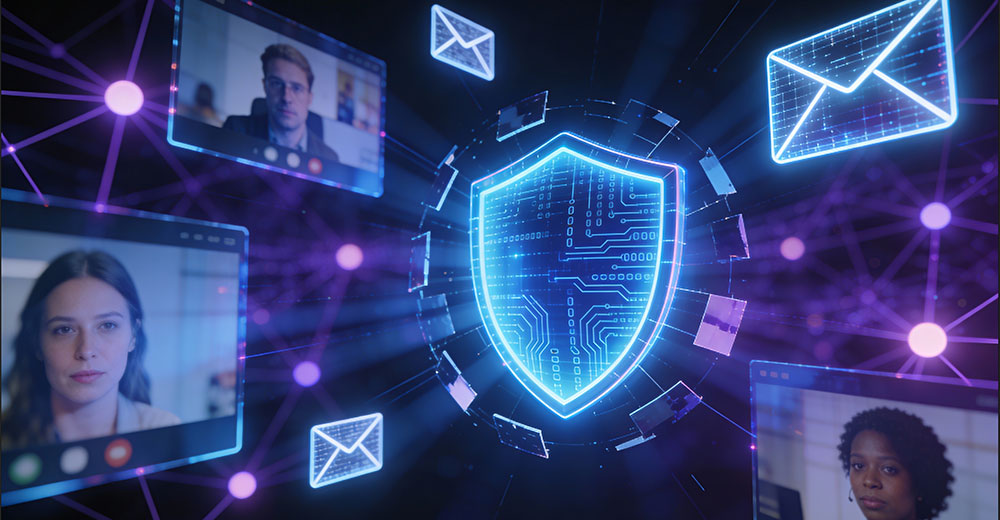
Deepfakes are no longer a futuristic threat discussed only in research labs or science fiction movies. They are here, they are accessible, and they are actively being used against organizations of every size. As artificial intelligence becomes more powerful and easier to use, cyber criminals and nation-state actors are weaponizing deepfake technology to undermine trust, manipulate people, and bypass traditional security controls. The result is a new era of AI-driven social engineering where identity itself is under attack.
This shift forces organizations to rethink how they define trust, authenticate users, and train employees. Deepfakes are not just a technical problem they are a human, procedural, and cultural challenge that cuts to the core of digital security.
Understanding Deepfakes Beyond Videos and Voices
When most people hear the word “deepfake,” they imagine a manipulated video of a public figure or a cloned voice used in a scam call. While those examples are real and dangerous, they only scratch the surface of the problem. Modern deepfakes go much deeper by attacking identity itself.
AI can now generate entirely synthetic people—complete with realistic faces, voices, documents, and behavioral patterns. These identities don’t rely on stolen data alone. Instead, they are manufactured from scratch, making them extremely difficult to detect using traditional fraud prevention methods. From the very first interaction, these fake identities can appear legitimate, confident, and trustworthy.
This represents a fundamental shift in how fraud works. Rather than exploiting gaps after authentication, deepfakes exploit the authentication process itself. Once a synthetic identity is accepted into a system, every downstream control may end up protecting the attacker rather than the organization.
Why Deepfakes Are So Dangerous to Digital Trust
At the heart of the deepfake threat is the erosion of digital trust. Many organizations still rely on static signals—such as facial recognition, voice authentication, or scanned documents—to verify identity. Deepfakes exploit these exact mechanisms.
There are three major risks that make deepfakes uniquely dangerous:
-
Authentication Breakdown
When identity verification relies on replayable or static signals, deepfakes can bypass them with alarming accuracy. A synthetic face or cloned voice can fool systems that were never designed to detect manufactured identities. -
Fraud at Scale
AI allows criminals to generate thousands of fake identities simultaneously. What used to be manual and time-consuming fraud has now become an industrialized process, increasing both frequency and impact. -
False Confidence
Deepfakes often pass existing controls, giving organizations a false sense of security. Fraud doesn’t always trigger alarms—it quietly grows until the damage is significant and costly.
Rather than replacing traditional fraud, deepfakes amplify existing weaknesses, making old security gaps far more expensive.
How Deepfakes Undermine Human Judgment
One of the most unsettling aspects of deepfakes is how effectively they exploit human psychology. Security systems often assume that once someone is authenticated, they are legitimate. Deepfakes break this assumption entirely.
AI-generated voices and videos can convincingly impersonate executives, employees, job candidates, or customers. These impersonations can bypass onboarding processes, help desk workflows, and approval chains that were never designed to question whether a person is real.
The real damage happens before technology even has a chance to respond. When a voice sounds right or a face looks familiar, people tend to move quickly. Authority, urgency, and emotional pressure cause employees to skip verification steps and override rational decision-making. A single believable executive call can authorize payments, override safeguards, or push sensitive actions through before anyone pauses to question them.
Why Deepfake Attacks Are Accelerating Rapidly
The rise of deepfake attacks is no accident. Several factors are accelerating their adoption by threat actors:
-
Low Cost and Accessibility: Many deepfake tools are cheap or free, with open-source models widely available.
-
Improved Quality: The output quality now exceeds what many verification systems were designed to handle.
-
Expanded Attack Surface: Video calls, social media, and remote work environments provide countless opportunities for impersonation.
What once required technical expertise is now a plug-and-play ecosystem. Criminals can purchase complete “persona kits” that include synthetic faces, voices, and digital backstories. This marks a transition from small-scale fraud to mass identity fabrication.
Research shows that roughly one in three organizations has already encountered deepfake fraud, putting it on par with long-standing threats like document fraud and traditional social engineering.
Deepfakes and the Disproportionate Impact on Businesses
While any organization can be targeted, deepfake-driven scams are especially dangerous for smaller or thin-margin businesses. A single fraudulent transaction or data breach can have an outsized impact on financial stability and long-term viability.
The consequences extend beyond immediate financial losses. Deepfakes can lead to data breaches, loss of control over systems and processes, operational disruption, and unplanned recovery costs. In many cases, reputational damage lingers long after the incident is resolved.
This makes deepfake resilience not just a cybersecurity issue, but a business survival concern.
Training Employees for the New Age of Deception
One of the most common defenses against deepfakes is employee training. However, effective training doesn’t focus on spotting visual or audio flaws. Those cues are rapidly disappearing as AI improves.
Instead, modern training emphasizes emotional awareness and behavioral analysis. When a message triggers fear, urgency, authority, or excitement, it should act as a warning sign. Emotional manipulation is often the first indicator of a deepfake-driven scam.
Employees are encouraged to slow down, analyze what is being asked, and question whether the request is out of the ordinary. Most importantly, they should verify requests through a secondary channel rather than relying on what they see or hear.
Deepfakes may be new, but the underlying deception tactics are as old as fraud itself.
Why “Never Trust, Always Verify” Is the New Standard
Relying on human detection alone is no longer enough. Visual and audio artifacts will continue to improve, making them unreliable indicators of authenticity. The focus must shift from recognition to verification.
Strong defenses include:
-
Multiple approval checks for sensitive actions like bank transfers
-
Callback procedures using out-of-band channels
-
Clear internal controls that cannot be bypassed by urgency
-
Secondary confirmation through trusted systems such as internal messaging platforms
The key mindset shift is moving from asking, “Is this real?” to asking, “What confirms this?” If a security control depends on someone recognizing a fake, it isn’t a control—it’s a gamble.
Identity as a Continuously Verified Asset
Deepfakes are not the root problem. They are a stress test that exposes how many organizations still rely on implicit trust. The long-term solution is treating identity as something that must be explicitly validated and continuously enforced by systems.
This means removing voice and video as standalone trust signals and embedding verification into every critical process. When trust is no longer assumed, deepfakes lose much of their power.
Organizations that adapt to this reality will not only reduce fraud but also build stronger, more resilient digital ecosystems.
Trust Must Be Earned, Not Assumed
Deepfakes represent a turning point in cybersecurity. They challenge long-held assumptions about identity, trust, and authentication. As AI-driven social engineering grows more sophisticated, organizations must respond with equally sophisticated strategies that combine technology, process, and human awareness.
The future of security isn’t about spotting better fakes it’s about designing systems where trust is never implicit and verification is always required. In that world, deepfakes become far less effective, and digital trust can begin to recover.
And also read our latest blog : 6 Reasons Why Delhi NCR No Longer Feels Liveable — And What Other Indian Cities Are Doing Better